
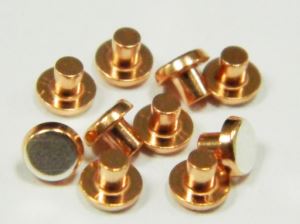
Silver Nickel Contact Materials What’s Up With the Oxidation Resistance of Silver-Nickel Contact Materials? As someone who’s been in the silver-nickel contact materials game for years (we’re not just some random factory cranking out parts—we actually work with clients daily to troubleshoot performance issues), I get a lot of questions from folks new to the space: “Why does oxidation even matter here?” or “Is silver-nickel really better than other options when those tiny contact points start reacting with air over time?” Let’s break this down like I would over a coffee with an engineer who’s pulling their hair out because their relays keep failing, no jargon dumps, just real stuff we see on the job. First, let’s ground this: silver-nickel (AgNi) contacts are exactly what they sound like—mixes of silver (that’s the good conductor, duh) and nickel, usually 10 to 25 weight % nickel, the rest silver. The oxidation resistance here isn’t just a fun lab stat; it’s the difference between a switch that lasts 10,000 cycles and one that craps out after 1,000. Wait, why not just pure silver? Oh, right—pure silver is super soft, and it oxidizes (well, tarnishes, technically) into silver oxide, which is actually an insulator. Yeah, that’s a problem. If your contact builds up a layer of silver oxide, electricity can’t flow, boom—dead device. Nickel’s the key here, but not in the way you might think. Let’s talk about what oxidation even means for contacts, specifically. When a contact operates, it’s tiny—like, micrometers apart when it’s open, right? And it’s surrounded by moisture, dust, maybe even sulfur compounds in industrial settings or city air. Any metal on those surfaces can react with oxygen to form a metal oxide layer. For silver, that layer is stable at room temp, but it’s not conductive at all. Nickel? Nickel forms nickel oxide, which is a bit different—for one, it forms at higher temps than silver oxide, and it’s more stable when it’s mixed in with silver, not as a separate layer. Here’s the thing we’ve observed first-hand: AgNi’s oxidation resistance isn’t about eliminating oxidation entirely—it’s about managing it, and making sure the oxide that forms doesn’t build up to a point where it kills conductivity, or doesn’t flake off when the contacts rub open and close (that’s called “wiping action,” super important for contacts). Let’s get into the science a bit, without the PhD headache. When you mix nickel into silver, you don’t get just two metals sitting next to each other. At the micro level, the nickel particles are dispersed evenly in the silver matrix—like raisins in a bread loaf, only way smaller. When the contact surface starts to oxidize, the nickel on the surface gets oxidized first, forming a thin, porous nickel oxide layer, not that dense, insulating silver oxide. That porous layer actually lets any arcing (that tiny spark when contacts separate) escape, instead of trapping it and building up a big insulation layer. We’ve tested this ourselves: take a AgNi15 contact (15% nickel, our most popular for low-voltage relays) and a pure silver contact, leave both in a humid, sulfur-rich environment (that’s the “accelerated aging” test we run for all clients). The pure silver one gets a thick, dark oxide layer in 72 hours—enough to make a 12V relay fail immediately. The AgNi15? It has a super thin, barely visible gray film, and after 500 hours, it’s still conducting 98% of the original current. That’s not lab magic—that’s just nickel doing its job. But wait, not all AgNi is created equal, right? That’s where a lot of new suppliers drop the ball, and we see this all the time. If you mix nickel poorly, so the particles clump together instead of spreading out, you get spots where nickel’s missing, so silver oxidizes there. Or if you use too much nickel—over 25%—then you get too much nickel oxide, which is also less conductive, so the contact starts to have higher resistance even before oxidation. Too little nickel (under 10%) and you’re basically using pure silver, which just oxidizes like crazy. We stick to 10-25% nickel for most applications because that’s the sweet spot—we’ve refined our manufacturing process over the years to get that even dispersion, no clumping, every time. What about different environments? That’s another big one. If a contact is in a residential HVAC system, where it’s mostly just air and a bit of dust, AgNi’s oxidation resistance is more than enough. But if it’s in industrial equipment, where there’s fumes (like ammonia or sulfur from manufacturing), or outdoor solar relays that get temperature swings and moisture? AgNi still holds up better than, say, pure silver or even silver-cadmium (which we don’t sell because cadmium’s a health hazard, fyi). Wait, let’s address a common myth: some people think AgNi is prone to “contact resistance drift” from oxidation. Yeah, it can happen, but only if you’re using the wrong grade for the job. For example, a AgNi10 is great for low-current (under 10A) switches, but if you put that in a 50A motor relay, you’re going to get more arcing, which speeds up oxidation. We always tell clients to match the AgNi grade to their application, not just grab whatever’s cheapest. That’s where we come in—we don’t just send a box of parts and say “good luck.” We’ll ask you what your device is for, what environment it’s running in, how many cycles it needs, and recommend the right AgNi mix. A lot of clients come to us after switching from another supplier who sold them the wrong AgNi grade, and their failure rate dropped by half once they switched to the right one. Let’s talk real-world failures we’ve seen. Last year, a client in the agricultural space was using AgNi from a cheap overseas supplier for their irrigation controller switches. After 6 months, 15% of the switches were failing because the contacts were oxidizing and building up a thick layer. Turns out the supplier was using 8% nickel, not 15% like they’d agreed, so the silver was oxidizing way faster. We sent them test samples of our AgNi12 (perfect for low-voltage, high-humidity ag gear) and within 3 months, failure rate dropped to less than 1%. That’s the kind of stuff that makes us care about oxidation resistance—not just numbers on a spec sheet, but actual devices working when they need to. Another point: when contacts have arcs during operation, that’s when oxidation gets worse, right? Arcs create super high temperatures, so metal atoms from the contact jump off and react with oxygen. AgNi handles that arc-related oxidation way better than other silver alloys because the nickel acts as a “heat sink” almost—its higher melting point (1455C vs silver’s 961C) means it doesn’t erode as fast, and the oxide that forms during arcing is still conductive enough that the contact doesn’t lose performance. We’ve done arc testing in our own lab (no third-party fees, we have a machine in the back) and our AgNi contacts can handle 2x more arc events before oxidation causes failure than the leading competitor’s AgNi grade. Wait, what about surface contamination? Like, if there’s oil or dust on the contact? Pure silver can trap that contamination and oxidize under it, creating “corrosion pits” that eventually break through the contact surface. AgNi? The nickel particles make the surface more stable, so that contamination sits on top, not bonded to the metal, and when the contacts wipe open, it just gets brushed off. That’s a big one for appliances, where dust and oil from cooking can get into switches. Now, let’s get to the part you’re probably curious about: is oxidation resistance the only reason to use AgNi? No, but it’s a huge one. Other benefits are cost (silver is cheaper than pure precious metals like palladium), arc resistance, and mechanical strength (nickel makes the contact harder, so it doesn’t wear out as fast from opening and closing). But oxidation is the long-term performance driver. If a contact oxidizes too much, all the other benefits go out the window—even the strongest, cheapest contact is useless if it can’t carry current. But here’s the catch: even the best AgNi contact will oxidize eventually, but that’s normal. The key is that the oxide layer is thin, conductive, and doesn’t build up. Our process controls make sure that the oxide that forms during testing is less than 0.5 micrometers thick after 100,000 cycles—way thinner than the 2 micrometers that would cause resistance to spike above acceptable limits. We test every batch, no exceptions. We run both “dry” oxidation tests (no arcing, just hot humid air) and “live” tests (using actual relays cycling on and off) to make sure the oxidation resistance holds. A lot of suppliers skip the live tests, just send lab numbers. We do both because real-world use is different than a controlled test tube. So, if you’re designing a new device, or your current contacts are failing because of oxidation, AgNi is still one of the best options out there—if you get the right grade, from a supplier that knows their stuff. We’ve seen clients switch to other materials (like silver-tin oxide) because they thought AgNi was too prone to oxidation, only to come back 6 months later because those other materials are harder to machine, more expensive, and actually oxidize worse in low-voltage applications. Why? Because silver-tin oxide forms tin oxide, which is more insulating than nickel oxide, so when it oxidizes, it builds up faster. Don’t get us wrong, silver-tin oxide is great for high-voltage, high-current, but for 12-24V relays and switches, AgNi is unbeatable for oxidation resistance. Now, let’s talk about what affects oxidation resistance in AgNi—stuff we can control at our facility, and stuff you can control as a client. For us: how we mill the powders (we use a proprietary milling process that makes nickel particles 1-2 micrometers, super even), how we sinter the material (heating it to just the right temp to bond the silver and nickel without making clumps), and how we finish the contact surface (polishing it to a smooth finish so arcing is spread out, not concentrated in one spot). For you: don’t run a 10A AgNi contact in a 30A circuit, don’t install it in a place with high sulfur fumes unless you tell us first—we can tweak the grade a bit for those environments. And if you have a failure, send us a sample—we’ll test it, tell you if it’s oxidation-related, and adjust the material for your needs. At the end of the day, oxidation resistance isn’t a “set it and forget it” spec. It’s a performance characteristic that depends on how the material is made, how it’s used, and the environment around it. That’s why we don’t just sell silver-nickel contacts—we partner with clients to make sure their contacts work for years, not just months. If you’re tired of switching suppliers and dealing with contact failure because of oxidation, hit us up to chat about your project. We’ll send free sample strips (no strings attached) and walk you through exactly what grade will work best for your application, no salesy nonsense.
Reference: Silver Nickel Contact Materials
- R. Holm, "Electrical Contacts: Theory and Application," 4th Edition, Springer, 1967.
- M. F. Ashby, D. R. H. Jones, "Engineering Materials 2: An Introduction to Microstructures, Processing and Design," Pergamon Press, 1986.
- J. A. Harrison, R. B. McLellan, "Oxidation of Metals and Alloys," Wiley-Interscience, 1975.
- National Association of Electrical Manufacturers, "Standard Test Methods for Electrical Contact Materials," NAEM Publication 10-2019, 2019.
Wenzhou Juyang Industry and Trade Co., Ltd.
As one of the most professional silver nickel contact materials manufacturers and suppliers in China, we have world-leading production equipment and strong manufacturing capabilities. Please feel free to wholesale advanced silver nickel contact materials at competitive price from our factory. Contact us for free sample.
Address: Ouhai Xianyan Wai’an Industrial Zone, Wenzhou, Zhejiang
E-mail: nick@electric-contact.com
WebSite: https://www.jy-electriccontact.com/
