What is an Ultra-Fast TVS Diode? TVS
If you’ve ever worked with electronics long enough, you’ve probably encountered the moment a circuit suddenly fails for no obvious reason—maybe a sensor stops responding, a display flickers out, or a control board dies right when you need it. More often than not, the culprit isn’t a faulty component or bad wiring. It’s a surge: a quick, sharp spike of voltage that sneaks through power lines, data cables, or even the air, overwhelming delicate semiconductors that can’t handle more than a tiny fraction of that energy. That’s where TVS diodes come in, and ultra-fast TVS diodes are the unsung heroes of this quiet battle.
Let’s start with the basics to make sure we’re all on the same page. A Transient Voltage Suppressor (TVS) diode is a semiconductor device designed specifically to clamp overvoltages and shunt surge currents away from sensitive components. Think of it like a safety valve for your circuit: when voltage stays within normal operating limits, the TVS diode acts like an open circuit, barely drawing any current. But when a surge hits—whether from electrostatic discharge (ESD), lightning, inductive switching, or grid noise—the TVS activates in nanoseconds, redirecting the excess current to ground and holding the voltage at a safe level so your microchips, sensors, and displays don’t get fried.
Now, the “ultra-fast” part. Not all TVS diodes are created equal. Standard TVS diodes have response times that range from a few nanoseconds to, at best, 10 nanoseconds. But some applications need protection faster than that. Imagine a high-speed data line, like a USB 3.2 or HDMI 2.1 connection, where signal transitions happen in sub-nanosecond intervals. A surge that arrives at a 10 nanosecond window could already travel several millimeters along a trace, damaging the termination components before a standard TVS can even react. That’s where ultra-fast TVS diodes step in: their junction design is optimized to switch from off-state to full conduction in less than 1 nanosecond, sometimes as fast as 0.5 nanoseconds. That tiny gap in time is the difference between a working circuit and a costly failure.
What makes ultra-fast TVS diodes so much faster than their standard counterparts? The answer lies in their semiconductor construction. Most standard TVS diodes are built with a PN junction, the same basic structure as a regular diode, but with larger breakdown voltage ratings to handle surges. Ultra-fast TVS diodes, though, use a modified junction design—often a Schottky barrier or a highly optimized avalanche junction with minimal carrier storage time. Carrier storage time is the delay that happens when a semiconductor diode switches from reverse-biased (off) to forward-biased (conducting): excess charge carriers get trapped in the junction, slowing the response. Ultra-fast designs eliminate or drastically reduce this trapped charge, so the diode can turn on almost instantly when a surge is detected.
That speed isn’t the only advantage. Ultra-fast TVS diodes also have a low dynamic resistance, which means they can handle high surge currents without a large voltage drop across themselves. A surge’s energy is calculated by the voltage across the diode and the current it shunts, so a lower dynamic resistance keeps the clamping voltage as close to the system’s safe limit as possible, rather than letting the voltage spike higher during activation. For devices like medical implants, automotive sensors, and 5G communication boards, that precision is non-negotiable: you can’t risk a clamping voltage that’s too high, even for a nanosecond, because it could damage a chip that costs hundreds of dollars to replace, or worse, compromise patient safety.
Let’s ground this in real-world use cases to see why ultra-fast TVS diodes matter so much. Take automotive electronics, for example. Modern cars have dozens of ECUs (Electronic Control Units) handling everything from anti-lock brakes to infotainment systems, and these systems are exposed to constant surges: inductive kicks from turning off motors, ESD from workers handling parts during assembly, and even transients from jump-starting a vehicle. The latest electric vehicles (EVs) have high-voltage battery systems with fast switching inverters that produce rapid voltage fluctuations; if a standard TVS can’t respond fast enough, those fluctuations can corrupt sensor data or cause a control module to reset mid-drive. Ultra-fast TVS diodes installed on the CAN bus, LIN bus, and low-voltage power lines in EVs ensure that these surges are clamped before they reach sensitive microcontrollers.
Another example: consumer electronics, especially high-speed devices like gaming laptops, 8K displays, and wireless chargers. Gaming laptops have multiple high-speed USB ports, HDMI, and Thunderbolt connections that handle data transfer rates up to 40Gbps. A surge from a nearby power surge, or even ESD from a user touching a USB cable, can travel down that cable in less than a nanosecond. A standard TVS would be too slow to clamp it, leading to corrupted data, a broken port, or even a dead motherboard. Ultra-fast TVS diodes placed at the port’s input protect these high-speed signals without adding significant capacitance, which would slow down the data transfer. That balance between speed and low capacitance is a key design feature for ultra-fast TVS diodes, because too much capacitance can interfere with high-frequency signals.
Industrial automation is another sector that relies heavily on ultra-fast TVS diodes. Factory floors have heavy machinery that switches motors on and off thousands of times a day, creating sharp, fast transients that ripple through power lines and I/O signals. Programmable Logic Controllers (PLCs) that run these factories have sensors and communication ports that can’t tolerate even a small voltage spike. If a surge bypasses the protection, a PLC might fail, halting an entire production line and costing thousands of dollars in downtime. Ultra-fast TVS diodes protect I/O modules, industrial Ethernet ports, and power supplies in these environments, ensuring continuous operation even in harsh, electrically noisy conditions.
Now, as a TVS supplier, I’ll be honest: not all ultra-fast TVS diodes are the same. There are a lot of low-quality parts on the market that claim to be ultra-fast but only hit 2 nanoseconds, which might be enough for basic applications but not for high-speed or high-reliability systems. The difference comes down to manufacturing quality. A properly designed ultra-fast TVS undergoes tight quality control during wafer processing to ensure the junction is uniform—any unevenness in the semiconductor will create hot spots during surge events, leading to premature failure. That’s why, as a supplier, we test every batch of ultra-fast TVS diodes for response time, clamping voltage, surge current rating, and capacitance to make sure they meet the strict requirements of applications like automotive, medical, and 5G.
It’s also important to clarify when you should choose an ultra-fast TVS over a standard one. If your circuit operates on slow signals (like a basic power supply, or a low-speed sensor that updates every few milliseconds), a standard TVS will work just fine, and it will be more cost-effective. But if you’re working with signals faster than 1Gbps, or in environments where transients can be particularly sharp (like automotive, industrial, or medical devices), ultra-fast is the way to go. Another thing to consider: ESD protection. ESD events often have rise times as fast as 0.1 nanoseconds, so even if you’re protecting a data line, an ultra-fast TVS is essential to guard against ESD damage.
Let’s talk about common misconceptions, too. Some people think that ultra-fast TVS diodes can handle higher surge currents than standard ones, but that’s not necessarily true. Response time and surge capacity are separate specifications: an ultra-fast diode might have a lower surge rating than a standard one of the same package, because the ultra-fast design is optimized for speed rather than raw current handling. That doesn’t mean it’s worse—it just means you have to match the diode to your application. For example, a small-signal ultra-fast TVS for a low-power data line won’t handle a 100A surge, but that’s fine because the maximum surge on a data line is usually much lower. For high-power applications like high-voltage lines, you’d pair a ultra-fast TVS with other protection components, or choose a larger ultra-fast model designed for higher surge currents.
Another misconception is that ultra-fast TVS diodes add too much capacitance to circuits, causing signal distortion. While it’s true that TVS diodes have a junction capacitance (since they’re diodes), modern ultra-fast designs use thin, optimized junctions to minimize capacitance. We offer ultra-fast TVS diodes with capacitance as low as 0.5pF, which is negligible for even the highest-speed signals. In comparison, a standard TVS might have 10pF or more, which would slow down a 10Gbps signal, making ultra-fast diodes the better choice for high-speed designs.
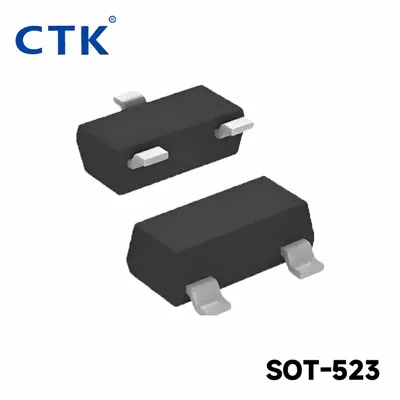
Now, if you’re working on a project where circuit reliability is critical, you might be wondering how to select the right ultra-fast TVS diode. First, identify the type of transient you’re protecting against: ESD, inductive switching, lightning, or power line surges. Each has a different rise time and energy, so you need a diode with a response time faster than the transient’s rise time. Next, check your circuit’s operating voltage to pick the right breakdown voltage for the diode—you want the breakdown voltage to be slightly higher than your system’s maximum operating voltage, so the diode stays off during normal use. Finally, consider the package size: ultra-fast TVS diodes are available in SMD packages as small as 0402, which is perfect for compact designs like wearables or small sensors.
As a supplier, I’ve seen first-hand how a wrong protection choice can derail a project. A few years back, a customer came to us after a batch of their new smart thermostats was failing in the field. They had used standard TVS diodes on the sensor inputs, and ESD from installation and handling was damaging the sensors, even though the diodes were rated for ESD. The problem was that the ESD events had a 0.2 nanosecond rise time, too fast for the standard TVS’s 8 nanosecond response time. We worked with them to switch to our ultra-fast TVS diodes, which had a 0.8 nanosecond response time, and their field failure rate dropped to almost zero. That’s the real value of ultra-fast TVS diodes: they don’t just protect circuits on paper, they solve real, costly problems.
If you’re designing a new product, troubleshooting a recurring failure, or just want to learn more about how ultra-fast TVS diodes can improve your circuit’s reliability, we’re here to help. Our team has decades of experience in surge protection, and we can work with you to select the right ultra-fast TVS diode for your specific application, whether it’s automotive, medical, industrial, consumer electronics, or 5G communication. We offer a range of ultra-fast TVS diodes in different package sizes, voltage ratings, and surge capacities, all tested to meet industry standards like AEC-Q100 for automotive and IEC 61000 for ESD and surge testing.
Don’t let unplanned surges turn your project into a headache. The right protection is a small investment that saves you from costly downtime, warranty claims, and product recalls. If you’re ready to discuss your surge protection needs, connect with our team to learn how our ultra-fast TVS diodes can keep your circuits safe and reliable.
Bidirectional Trigger Diode References
- Application Note: Transient Voltage Suppressor (TVS) Diodes: Selection and Application, Texas Instruments.
- Standard for Surge Immunity Testing, IEC 61000-4-5.
- Automotive Electronics Reliability Standard, AEC-Q100.
- Semiconductor Junction Carrier Storage Time and Switching Speed, IEEE Transactions on Electron Devices, Volume 58, Issue 10, 2011.
Tongke Electronic Co., Ltd.
Tongke Electronic Co., Ltd. is one of the most experienced tvs manufacturers and suppliers in China, featured by quality products and low price. Please rest assured to wholesale advanced tvs made in China here from our factory. Contact us for pricelist.
Address: No.3,Chayuan Rd, Street 3, AilingKan, Dalingshan, Dongguan, Guangdong, China.
E-mail: tina@ctk-elec.com
WebSite: https://www.ctkchip.com/
