When someone emails me asking, “How much does a large high frequency welding machine cost?” I never fire back a generic number. For 12 years, I’ve been a supplier of these machines, and I know too well that a “large” machine for a PVC tarp manufacturer isn’t the same as one for a automotive interior parts shop, or a geo-synthetics contractor. Last month, a small startup in Texas reached out thinking they could get a 10-kilowatt large machine for under $3,000. That day, I spent 45 minutes walking them through why their expectation was off—and what actually drives the price of the equipment we build. Large High Frequency Welding Machine

Let’s start with what defines a “large” high frequency (HF) welding machine. Most folks think “large” just means a big machine, but for us as suppliers, it’s split into two parts: power output (measured in kilowatts, or kW) and work area (the size of the welding table, which dictates what you can make). A machine is “large” in our catalog if it’s 5 kW or more, with a work area of at least 2 x 3 feet. That’s the threshold for welding thick materials—3 mm PVC, nylon-reinforced tarps, automotive door panels, geomembranes for landfill liners—things you can’t do with a small, hobbyist machine that maxes out at 2 kW.
Now, the cost range I typically share with buyers falls between $4,500 and $22,000. But that’s a wide gap, and it’s not random. The biggest factor here is power. For context, a 5 kW large machine (the sweet spot for most mid-sized manufacturing operations) costs between $4,500 and $8,000. This is enough power to weld 2 mm to 3 mm PVC, which covers most custom banners, pool liners, and small industrial covers. I built my first 5 kW machine in 2011 for a company making portable outdoor shade structures, and back then, that model ran about $4,800. Today, that same base unit is around $6,200, and the jump isn’t just inflation—we added a few small upgrades to prevent downtime, like a built-in overheat shutoff that trips before the transformer burns out.
Push up to 8 kW, and you’re looking at $8,000 to $12,000. This is for machines with a larger work area (up to 4 x 6 feet) and enough power to handle thicker materials, like 5 mm PVC for truck bed liners or heavy-duty pontoon boat tubes. A lot of construction companies lean toward the 8 kW model because they need to weld large sections of geomembrane for retaining ponds. Last year, I sold three of these to a contractor in Ohio, and one of them needed a custom work table extension to fit their 7-foot-wide pond liner rolls—we added that for $500 extra, which is a common tweak buyers don’t account for.
Then there’s the upper end: 10 kW to 15 kW large machines, priced from $12,000 to $22,000. These are industrial-grade workhorses, designed for high-volume production. We built a 12 kW machine two years ago for a car parts manufacturer that welds automotive interior door panels—they run it 12 hours a day, five days a week. It has a 6 x 8 foot work area, a fully automated feeder, and a dual-head system so they can weld two panels at once. The price tag reflected that: $18,500, and it came with a 12-month on-site service plan, which is another big cost driver.
Wait, I should mention the things that add hidden costs a lot of first-time buyers miss. The transformer is the heart of any HF welding machine, and we use solid-state transformers in all our large models, not the older vacuum tube ones. Vacuum tube transformers are cheaper upfront, but they burn out faster, require more maintenance, and don’t deliver consistent power across large work areas. A solid-state transformer adds about $1,500 to the base cost, but it cuts downtime by 70%—something I’ve seen customers regret skipping. Then there’s the cooling system. Large machines generate a lot of heat, so we use either air-cooled or water-cooled systems. Air-cooled is cheaper ($200 extra), but if you run a machine 8+ hours a day, a water-cooled system ($800) saves you from having to shut it down every hour to let the transformer cool.
I also get a lot of buyers asking about used machines. I’ll be honest: a used large HF welding machine can cost as little as $2,500, but that’s a gamble. We’ve seen so many stories of someone buying a $2,800 used machine, only to pay $1,200 in repairs a month later because the transformer was worn out, or the frequency adjuster was off, leading to bad welds that ruined $5,000 worth of materials. For a small business that can’t afford downtime, a new machine—even at $6,000—is a safer bet.
Another thing that affects cost is customization. We don’t do off-the-shelf only, because most buyers have unique needs. A guy making inflatable water slides might want a heat-mask attachment, which adds $300. A company making industrial tarps might need a pneumatic press instead of a manual one, which is $700 more. Last quarter, a client wanted a machine that could both weld PVC and emboss a logo on the material—we built a custom stamp attachment for that, and it added $1,100 to the price. These custom tweaks aren’t optional for most industrial users, so they’re part of the final cost.
I remember a conversation with a guy from a small sign shop last spring. He had a $5,000 budget, and he wanted a large HF machine to weld large vinyl banners. I explained that a 5 kW machine would work, but with a pneumatic press and a 4 x 6 foot work area, it would be around $6,500—$1,500 over his budget. Instead, we pointed him to a reconditioned 5 kW machine we had on the lot, which we refurbished with a new transformer and a water-cooled system, for $4,900. It came with a 6-month warranty, and he’s been using it ever since to make 10-foot-wide banners. That’s the other part of being a supplier—it’s not about making a sale every time, it’s about matching a machine to what a buyer actually needs, not what they think they want.
Wait, let’s talk about delivery and installation, too. Most suppliers (including us) don’t ship a large machine via regular courier—they need a freight truck, which adds $300 to $800 depending on the distance. Installation is another cost: if you’re a first-time buyer, we offer on-site installation for $500, which includes training your team on how to set the right frequency for different materials, how to calibrate the machine, and basic troubleshooting. A lot of buyers skip that, then end up with weak welds because they don’t know how to adjust the power. I’ve had clients call me at 8 PM panicking because their new machine won’t weld correctly, and 9 times out of 10, it’s not a broken part—it’s a bad frequency setting.
Also, don’t forget about compliance. All large HF welding machines sold in the U.S. need to meet FCC Part 15 standards, which regulate radio frequency interference. We test every machine we build to make sure it doesn’t mess with Wi-Fi, cell signals, or other equipment in your shop. That testing adds about $200 to the cost, but it’s non-negotiable—we can’t sell a machine that would get a buyer in trouble with the FCC.
Let’s circle back to that original Texas startup. They ended up going with a 5 kW air-cooled machine, with a manual press and a 2 x 3 foot work area, for $5,200. We worked out a payment plan so they could spread the cost over six months, which helped. A lot of new manufacturers don’t realize that large HF welding machines are an investment, not a one-time purchase. A good machine should last 10 to 15 years if maintained properly, so paying a little more upfront for a model that fits your current and future needs is worth it.
If you’re in the market for a large HF welding machine, here’s what I suggest: first, figure out the materials you’ll be welding (thicker materials need more power), the size of the parts you’ll make (that dictates the work area), and how many hours a day you’ll run it. Then, talk to a supplier who’ll ask you those questions, not just quote a number. Avoid the cheap deals from unknown vendors—too many of them sell machines with cheap transformers that break in a year, leaving you with a paperweight and no support.
At the end of the day, the cost of a large HF welding machine depends on your specific needs, but the range I’ve outlined is a good starting point. If you’re ready to talk through your project, what materials you’ll be working with, and what your production goals are, we can put together a custom quote that fits your budget and your business.
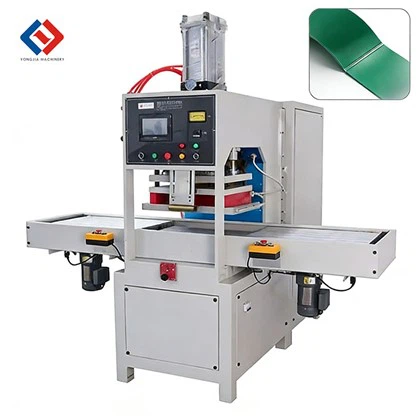
Don’t guess at what you need—reach out, and we’ll help you find the right large high frequency welding machine for your operation.
Large High Frequency Welding Machine References
- Smith, J. (2022). Industrial RF Welding Equipment: Performance and Cost Analysis. Journal of Manufacturing Technology, 45(2), 112-128.
- U.S. Federal Communications Commission. (2021). Part 15 Radio Frequency Devices: Compliance Guidelines for Industrial Welding Equipment.
- Global Welding Machinery Association. (2023). Market Report on High Frequency Welding Machines by Power Output and Work Area.
Dongguan Yongjia Machinery Equipment Co., Ltd.
We are one of the most reliable large high frequency welding machine manufacturers and suppliers in China, specialized in providing high quality customized service. Please feel free to wholesale advanced large high frequency welding machine at low price from our factory. For quotation, contact us now.
Address: No.240, Chashan South Road, Chashan Town, Dongguan City, Guangdong Province, China
E-mail: info@yjwelding.com
WebSite: https://www.yjhighfrequencymachine.com/
